
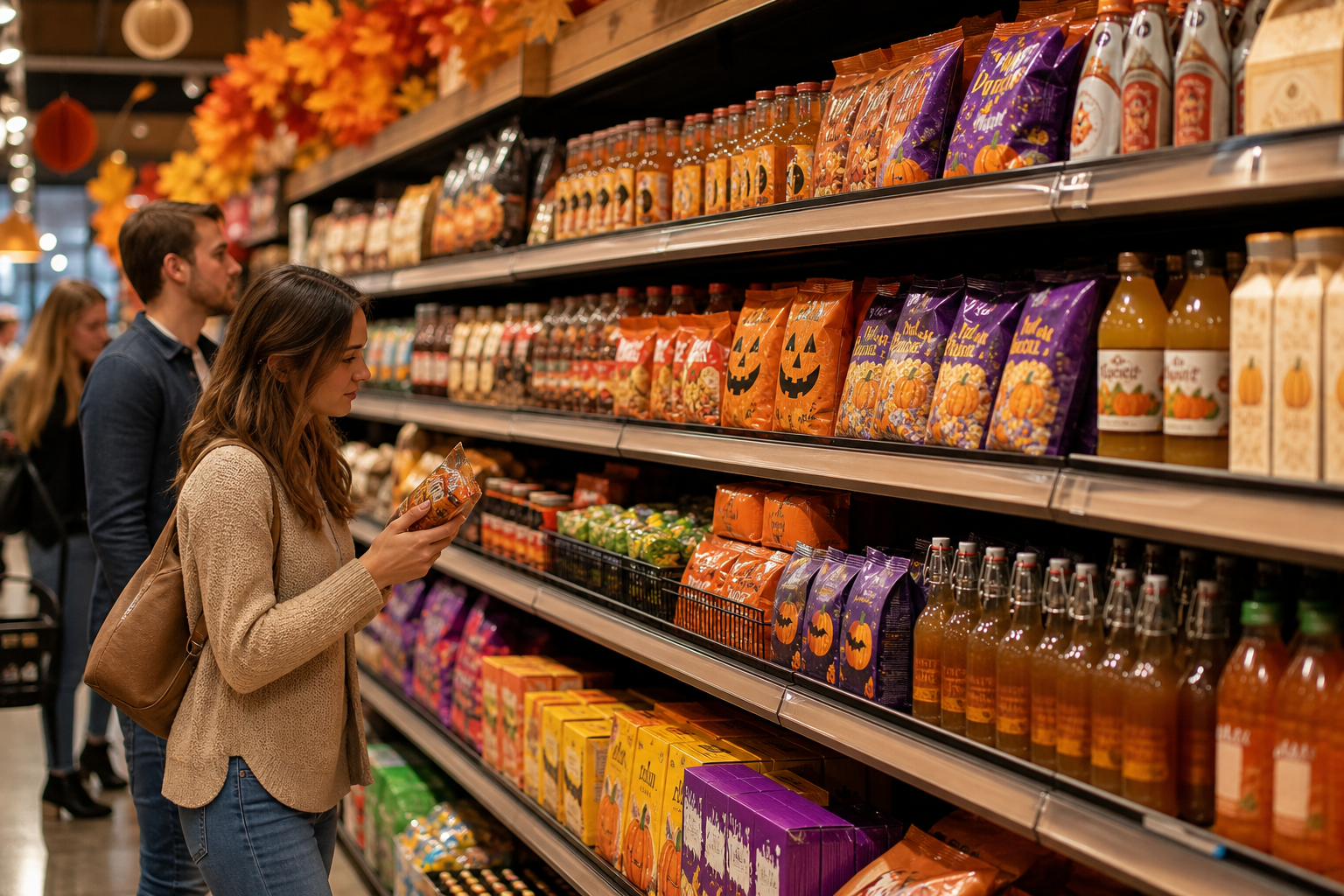

A U.S. seasonal launch is not finished when a limited package leaves the factory. Retail reset dates, promotional weeks, case packs, inner wraps, allergens, replenishment, and inventory exit must operate as one program. Food & Wine's September 10, 2026 report on more than 100 Trader Joe's fall products and the Specialty Food Association's September 8 posting on a Häppy Candy Halloween launch in roughly 2,000 Target stores provide a practical framework for connecting Japanese snacks, drinks, noodles, and seasonings with U.S. seasonal demand.
Contents
- What the two articles show
- Seasonal products are programs, not flavors
- Four fall occasions for Japanese foods
- Product, packaging, and label design
- Retail selling and supply planning
- Preventing leftovers and brand damage
- A 12-month execution calendar
- Conclusion
1. What the Two Articles Show
Food & Wine reports that Trader Joe's 2026 fall assortment spans more than 100 meals, snacks, desserts, and drinks. Pumpkin appears in soup, mac and cheese, ravioli, bagels, candy, ice cream, coffee, and alcohol, while apple, maple, and cinnamon repeat across departments. This is not one popular flavor. It is a store experience that lets shoppers discover the season through different uses on repeated visits.
The SFA-posted Häppy Candy announcement describes a Halloween variety pack in approximately 2,000 Target stores. Sixteen individual bags, two limited flavors, seasonal shapes, and positioning free from the nine major allergens are linked to trick-or-treating, school events, classrooms, and parties. Target exclusivity and while-supplies-last availability make the retail program part of the product.
The Häppy Candy item is a company press release, not independent sales validation. The Trader Joe's article lists products but does not report item-level performance. Neither proves that a fall flavor will sell. Together, however, they reveal operating requirements behind broad seasonal assortment and national limited distribution.
2. Seasonal Products Are Programs, Not Flavors
A common mistake is to finish a fall flavor or package before looking for a U.S. customer. Category reviews, samples, label review, orders, production, ocean freight, entry, distribution centers, and store resets create a long sequence. A September product cannot be sold into retail in September. Planning may need to start more than 12 months before the shelf date.
Seasonal products also need a business job. They can recruit a new shopper, lift basket size, create cross-department movement, serve gifting and sharing, or introduce the permanent range. Different jobs require different sizes, prices, inner packs, flavor counts, placements, and promotion. The first question is not whether the item looks seasonal; it is which purchase behavior the limited item should change.
Forecast error is especially costly because the selling window is short. A stockout may not be recoverable, while excess inventory loses relevance rapidly. Long lead times from Japan make initial quantity, replenishment feasibility, alternate channels, and end-of-season terms more important than in a core launch.
3. Four Fall Occasions for Japanese Foods
The first is Halloween sharing. Japanese gummies, candy, rice crackers, and baked snacks offer individual wrapping and flavor variety. Japanese inner packs, however, may not automatically fit U.S. distribution. Count, English information, major allergens, ease of opening, inner-to-outer lot traceability, and school or venue policies all need review.
The second is the warm beverage ritual. Hojicha, genmaicha, matcha, yuzu tea, ginger drinks, and amazake can connect with colder weather, reading, home time, and guests. Bridges such as maple hojicha, apple and ginger, or pumpkin and kinako are possible. Heavy sweetening or flavoring can erase the product's long-term value, so the relationship between limited and core versions matters.
The third is easy meals. Trader Joe's connects fall with soup, lasagna, ravioli, and mac and cheese. Japanese options could include mushroom udon, chestnut rice, sweet-potato curry, pumpkin croquettes, or hot-pot soup base. Cold-chain costs may make shelf-stable soup bases, mixed-rice seasonings, dried noodles, or freeze-dried foods better first tests than frozen or chilled items.
The fourth is adult alcoholic and alcohol-free occasions. Fall beverage shelves use spice, apple, pumpkin, and barrel cues. Sake, shochu, and plum wine can share an occasion with tea- or citrus-based alcohol-free drinks, concentrates, and cocktail ingredients. Alcohol distribution varies by state, so licensed partners should review it separately and early.
4. Product, Packaging, and Label Design
Divide seasonal SKUs into a flavored version of a core item, a fully seasonal product, and a limited pack. A core flavor change can use existing lines. A seasonal-only product offers novelty but creates ingredient and package risk. A limited pack can change occasion without reformulating the contents, making it attractive for a first U.S. test. Multi-packs fit sharing but add packing cost, capacity constraints, and label alignment questions.
The English flavor name must be immediately understandable and still explain why the product is Japanese. Autumn Matcha is vague; Pumpkin Spice Matcha risks disappearing among competitors. A brief cue such as roasted aroma, bright yuzu acidity, or deep brown-sugar flavor can supply a reason to choose. Japanese script should be translated and pronounced, not used only as mysterious decoration.
Allergen and nutrition review belongs at the beginning. Japanese seasonal recipes may introduce wheat, milk, egg, soy, sesame, or nuts. Outer package, inner pack, e-commerce image, and shelf communication should remain consistent. Low sugar, no artificial colors, and allergen-free positioning need definitions, analysis, controls, and qualified review.
Shelf life should be agreed as days remaining at delivery. Ocean transit, entry, and distribution-center dwell reduce the usable window. Establish last delivery and last sale dates. The quantity that can sell before markdowns begin is the practical ceiling for a seasonal item.
5. Retail Selling and Supply Planning
The retail proposal should include launch week, suggested retail, wholesale price, case pack, pallet pattern, minimum order, initial capacity, replenishment cutoff, remaining shelf life, promotional assets, and exit plan. Scarcity should not be presented in a way that looks like supply unreliability. Define the limited period while proving that committed initial volume can be filled.
Build optimistic, base, and conservative forecasts using weekly units per store, initial display, replenishment, and regional variation. Do not multiply only by store count. In a 2,000-store launch, even a one-case-per-store error creates a large inventory position. Importers must align factory runs, retail order units, and warehouse handling units.
Promotion should show the occasion. For Halloween, separate trick-or-treat, classroom, office, party, and household sharing. For tea, show morning, afternoon, evening, guest service, temperature, sweetness, and food pairing. Seasonal color alone does not answer when, with whom, or how the item is used.
6. Preventing Leftovers and Brand Damage
Seasonal risk includes more than disposal. Deep markdowns can lower price expectations for the core range. Use staged orders, regional allocations, e-commerce transfer, foodservice repurposing, and contents that can return in year-round packaging. Seasonal claims still must not mislead consumers after the event.
Stockouts also damage trust. Demand created by media is wasted when shoppers cannot find the product. If replenishment is impossible, point shoppers to a core substitute or nearby inventory. The limited SKU should create a designed next step into the permanent range.
Evaluate units alongside markdown rate, out-of-stock days, returns, waste, impact on core items, email signups, and branded search. A low-margin seasonal item may succeed if it grows the core range. A sellout with inadequate gross profit and frequent logistics failures may not be repeatable.
7. A 12-Month Execution Calendar
Twelve months before launch, select the event, channel, price, and format, and confirm category review timing. Nine months before, prepare prototypes, preliminary cost, label concepts, and available capacity. Six months before, lock specifications and quantities based on buyer feedback and order packaging. Four months before, begin production, testing, freight booking, and promotional development.
Two months before, reconfirm entry documents, warehouse appointments, distribution-center bookings, and store allocation. One month before, prepare the product page, store locator, FAQ, and substitute SKU. After launch, review sales, inventory, stockouts, and markdowns weekly. Once the replenishment deadline passes, switch to exit management. Within four weeks after the season, decide which flavor, size, geography, and promotion should return next year.
8. Conclusion
The Trader Joe's and Target examples show more than the size of the U.S. seasonal shelf. Retailers need both assortment that extends a season across occasions and supply execution that delivers a limited pack nationally. Japanese brands can turn a seasonal novelty into a recurring buyer asset by planning backward from the occasion, reset, logistics, and exit.
Umamill Co., Ltd.'s lineup of roughly 7,000 Japanese food SKUs can help compare candidates across snacks, tea, drinks, dried noodles, and seasonings. Reviewing shelf life and order units alongside the choice between a limited pack and a U.S.-specific flavor can make the first proposal more realistic.
---------------------------------------------------------------------
Sources
“Trader Joe’s Just Dropped More Than 100 Fall Items — Here’s the Complete List,” Food & Wine, September 10, 2026https://www.foodandwine.com/trader-joes-fall-items-2026-12113054
“Häppy Candy™ Launches Nationwide at Target with Limited-Edition ‘Haunted Edition’ Halloween Variety Pack,” Specialty Food Association, September 8, 2026
https://www.specialtyfood.com/news-media/news-features/member-press-releases/happy-candy%E2%84%A2-launches-nationwide-at-target-with-limited-edition-haunted-edition%E2%80%9D-halloween-variety/
“Food Allergies,” U.S. Food and Drug Administration (context)
https://www.fda.gov/food/nutrition-food-labeling-and-critical-foods/food-allergies
“Label Claims for Food & Dietary Supplements,” U.S. Food and Drug Administration (context)
https://www.fda.gov/food/nutrition-food-labeling-and-critical-foods/label-claims-food-dietary-supplements
“FSMA Final Rule for Foreign Supplier Verification Programs,” U.S. Food and Drug Administration (context)
https://www.fda.gov/food/food-safety-modernization-act-fsma/fsma-final-rule-foreign-supplier-verification-programs-fsvp-importers-food-humans-and-animals