
What You Will Learn
Sourcing Japanese condiments for U.S. foodservice requires buyers to evaluate more than flavor. Application, product specifications, allergens, packaging, opened-product quality, logistics, and supply continuity must all be considered. This guide explains how to select foundational categories, calculate menu cost, run kitchen tests, review supplier documentation, and prepare for supplier discussions.
Table of Contents
- Who This Guide Is For
- Why U.S. Foodservice Operators Are Using Japanese Condiments
- Foundational Categories to Evaluate First
- Product Specifications and Supplier Documentation
- Connecting Menu Development with Procurement
- Foodservice Packaging, Logistics, Storage, and Opened-Product Quality
- Supplier Meeting Checklist
- Taking the Next Step with umamill
1. Who This Guide Is For
This guide is intended for U.S. foodservice businesses seeking to introduce Japanese condiments and commercial ingredients, including:
- Restaurant groups
- Foodservice distributors
- Hotels
- Institutional dining and catering companies
- Central production kitchens
- Ghost kitchens
- Prepared-food and deli operators
- Grocery prepared-food departments
- Specialty food retailers
- Culinary and product-development teams
- Procurement and quality-assurance teams
Relevant product categories include:
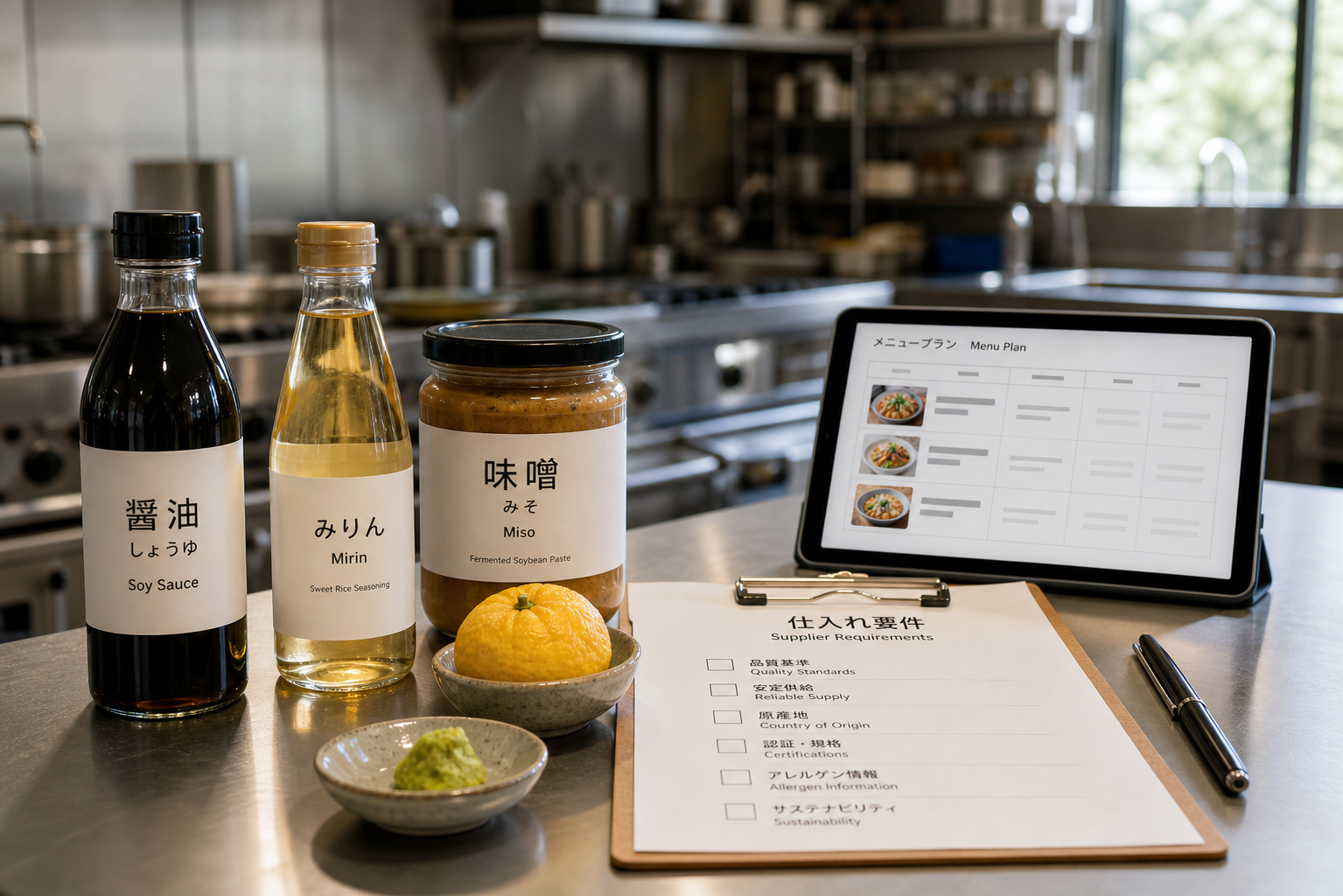
- Soy sauce and tamari
- Miso
- Mirin and mirin-style seasonings
- Dashi and concentrated soup bases
- Yuzu, ponzu, and citrus seasonings
- Furikake
- Shio koji
- Wasabi
- Shichimi and sansho pepper
- Dressings and sauces
- Refrigerated, frozen, and shelf-stable commercial ingredients
This article is not a home-cooking or recipe guide. It focuses on determining whether a product can be used consistently in U.S. commercial kitchens, meet target food costs, and be supplied at the volume required.
Japanese Condiments Beyond Japanese Restaurants
Japanese condiments are increasingly relevant to a wide range of foodservice concepts, including:
- Casual restaurants
- Fast-casual concepts
- Hotel restaurants
- Bars and cafés
- Prepared-food and deli operations
- Fusion restaurants
- Plant-forward concepts
- Chains developing limited-time offers
They can provide:
- Umami
- Fermented flavor
- Acidity and aroma
- Visual finishing elements
- Applications across meat, seafood, and vegetables
- Compatibility with plant-based menus
- Flexible concepts for limited-time offers, or LTOs
Condiments may represent a small portion of a recipe by weight, but they can determine the flavor and consistency of the entire menu item. Buyers must therefore evaluate supply continuity, specifications, opened-product quality, allergens, cost, and kitchen usability.
2. Why U.S. Foodservice Operators Are Using Japanese Condiments
Japanese condiments are not limited to traditional Japanese food. They can function as menu-development tools across multiple cuisines.
| Category | Common Applications | Menu Function |
|---|---|---|
| Soy sauce and tamari | Grilling, marinades, sauces, dressings | Umami, salt, color, roasted flavor |
| Miso | Soups, glazes, butter, mayonnaise, marinades | Fermented flavor, richness, texture |
| Mirin and mirin-style seasoning | Glazes, sauces, braises | Sweetness, gloss, depth |
| Dashi | Soups, noodles, risotto, sauces, prepared foods | Foundational umami and finish |
| Yuzu and ponzu | Seafood, chicken, vegetables, dressings, drinks | Acidity, aroma, freshness |
| Shio koji | Meat and seafood preparation, marinades | Umami, moisture retention, tenderness |
| Furikake, shichimi, and sansho | Final garnish and seasoning | Color, aroma, texture, visual identity |
| Wasabi | Sauces, dips, sandwiches | Heat, aroma, clean finish |
Avoid Unnecessary SKU Proliferation
Adding too many specialized condiments can make inventory, staff training, and menu execution more difficult.
During the initial stage, buyers should prioritize foundational SKUs that can support several menu items.
A practical starting group may include:
- A core soy sauce or tamari
- A versatile miso
- A dashi or soup base
- A yuzu or ponzu product
- A finishing seasoning such as furikake, shichimi, or sansho
More specialized products—such as a particular regional soy sauce, white miso, red miso, or vegan dashi—can be introduced after sales and menu performance have been evaluated.
Culinary and procurement teams should share a clear understanding of where each product will be used and how quickly it will be consumed.
3. Foundational Categories to Evaluate First
1. Soy Sauce and Tamari
Soy sauce and tamari can be used in grilling, sauces, dressings, and marinades.
Evaluate:
- Sodium level
- Color
- Aroma
- Umami
- Flavor after heating
- Viscosity
- Packaging format
- Soy and wheat allergens
- Basis for any gluten-free claim
Tamari should not automatically be assumed to be gluten-free. When gluten-free positioning is required, review the ingredients, manufacturing process, cross-contact controls, and supporting test information.
Under FDA rules, foods labeled “gluten-free” generally must contain less than 20 parts per million of gluten and meet other applicable conditions. See the FDA’s Gluten and Food Labeling guidance.
2. Miso
Miso can be used in soups, sauces, glazes, butter, mayonnaise, dressings, marinades, and vegetable dishes.
Available styles may include:
- White miso
- Red miso
- Blended miso
- Coarse or smooth miso
- Miso containing dashi
- Additive-free products
- Commercial miso pastes
Evaluate:
- Sodium
- Sweetness
- Color
- Texture
- Viscosity
- Aroma after heating
- Soy and wheat allergens
- Dashi or animal-derived ingredients
- Storage after opening
3. Mirin and Mirin-Style Seasonings
Mirin and mirin-style seasonings may differ in alcohol content, sugar, ingredients, labeling, and distribution requirements.
Confirm:
- Alcohol by volume
- Sugar content
- Sodium
- Ingredients
- U.S. product classification
- Possible alcohol-related requirements
- Storage and distribution conditions
- Gloss and sweetness after cooking
- Performance in sauces
Products containing alcohol may be classified or handled differently depending on their formulation and intended use. Confirm the applicable requirements with the importer, customs broker, and, when appropriate, TTB and state authorities.
4. Dashi
Dashi products may be based on kombu, bonito, dried sardines, shiitake mushrooms, or blended ingredients. Available formats include powders, liquids, concentrates, refrigerated products, and frozen products.
Evaluate:
- Presence of animal-derived ingredients
- Suitability for vegan menus
- Fish, soy, wheat, and other allergens
- Sodium
- MSG and yeast-extract use
- Dilution ratio
- Solubility
- Aroma after heating
- Sedimentation
- Quality after opening
5. Yuzu, Ponzu, and Citrus Seasonings
Yuzu and ponzu can be used with seafood, chicken, vegetables, dressings, sauces, beverages, and desserts.
Confirm:
- Percentage of juice
- Added flavors
- Acidity and pH
- Sodium
- Sugar
- Aroma after heating
- Emulsification with oil
- Separation under refrigeration
- Aroma and quality after opening
6. Finishing and Preparation Ingredients
Furikake, shichimi, sansho, wasabi, and shio koji can significantly change a menu item even when used in small quantities.
However, these products may become slow-moving inventory if their applications are not clearly defined.
For furikake and spice blends, review sesame, fish, crustaceans, and other allergen sources. Sesame is included among the major food allergens in the United States. Current information is available in the FDA’s Food Allergen Labeling Guidance.
4. Product Specifications and Supplier Documentation
In foodservice procurement, flavor is only one part of the evaluation. Product specifications and kitchen usability are equally important.
Product Specifications to Review
| Area | Information to Confirm |
| Packaging and cases | Unit size, case pack, inner packs, carton dimensions, weight |
| Quality | Color, aroma, viscosity, sodium, sugar, Brix, pH, alcohol content |
| Ingredients | Allergens, gluten, animal-derived ingredients, additives |
| Storage | Unopened and opened shelf life, storage temperature, refrigeration or freezing |
| Labeling | Country of origin, lot code, date information, Nutrition Facts inputs |
| Certifications | Food safety, organic, gluten-free, halal, kosher |
| Logistics | Carton weight, pallet configuration, stacking, temperature conditions |
Evaluate Kitchen Usability
Operational questions include:
- Can the container be poured with one hand?
- Can a pump or dispenser be attached?
- Is decanting required?
- Can the full contents be removed efficiently?
- Does the package fit in the refrigerator or storage area?
- Can the product be used within its opened shelf life?
- Can usage be standardized across locations?
- Does the package reduce dripping and mess?
Supplier Documentation
Depending on the product and customer, buyers may request:
- Product specification
- Ingredient and additive information
- Allergen statement
- Nutrition data
- Certificate of Analysis
- Relevant microbiological and food-safety test reports
- Manufacturing-process information
- Facility certifications and audit information
- Lot control and traceability records
- Shelf-life support
- Complaint, corrective-action, and recall procedures
- Information required for U.S. labeling
Prioritize Documentation by Stage
Smaller Japanese manufacturers may not have every document requested by a large U.S. chain available in English at the first meeting.
A phased review can prevent unnecessary delays.
Initial Screening
- Product specification
- Ingredients and allergens
- Package and case information
- Shelf life and storage
- Basic price and supply terms
Menu Development and Evaluation
- COAs and test reports
- Nutrition data
- Manufacturing process
- Lot-to-lot variation
- Opened-product quality
- English-label information
Final Approval and Onboarding
- Facility certification and audit information
- Quality agreement
- Traceability
- Complaint and recall procedures
- Ongoing supply plan
Direct Imports into the United States
When importing directly from Japan, buyers should also determine responsibility for:
- FDA food-facility registration
- Prior Notice
- FSVP
- English-language labeling
- Country-of-origin marking
- Importer of Record
- Customs clearance, warehousing, and delivery
An overview is available on the FDA’s Importing Food Products into the United States page.
5. Connecting Menu Development with Procurement
A product selected only by the procurement team may not be adopted successfully by kitchen operations. It may taste good but be difficult to use, exceed the target food cost, or deteriorate before the container is finished.
The following teams should use a shared evaluation scorecard:
- Culinary and menu development
- Procurement
- Restaurant operations
- Quality assurance
- Logistics
- Finance and cost management
Shared Evaluation Criteria
| Evaluation Area | Questions to Ask |
| Sensory | Flavor, aroma, color, texture, finish |
| Menu performance | Heat stability, dilution, emulsification, compatibility |
| Cost | Price, usage per serving, yield, waste |
| Operations | Measuring, dispensing, preparation time, cleaning |
| Quality and labeling | Allergens, label impact, storage |
| Supply | MOQ, lead time, alternatives, continuity |
Calculate Cost Per Serving
Condiment cost per serving = Total landed cost per package ÷ Usable servings after dilution and yield
The calculation should also account for:
- Dilution ratio
- Actual usage
- Product remaining in the container
- Waste after opening
- Portioning variation
- Preparation and labor time
Menu-Application Examples
Miso Sauce for an LTO
Evaluate:
- Usage per serving
- Dilution ratio
- Yield
- Flavor after heating and holding
- Preparation time
- Opened shelf life
- Remaining inventory after the promotion
- Supply capacity if the item becomes permanent
Yuzu Ponzu Dressing
Evaluate:
- Acidity and sodium
- Emulsification with oil
- Separation after refrigeration
- Aroma retention
- Quality after dilution
- Dispensing through bottles or pumps
Furikake as a Finishing Ingredient
Evaluate:
- Visual impact
- Sodium
- Usage per serving
- Moisture-related clumping
- Ease of application during final plating
- Allergen controls
Use a Three-Stage Testing Process
- Bench test: The culinary team confirms flavor and formulation.
- Pilot-kitchen test: The product is tested using actual equipment and procedures.
- Restaurant test: Preparation time, staff training, waste, and customer response are measured.
If an LTO may become a permanent menu item, share demand forecasts with the supplier during the test period and confirm whether production can scale.
6. Foodservice Packaging, Logistics, Storage, and Opened-Product Quality
Packaging format directly affects kitchen efficiency, sanitation, waste, and food cost.
Compare Packaging Formats
| Package | Advantages | Key Considerations |
| Small bottle or pouch | Sanitary and easy to use quickly | Higher unit cost and more packaging waste |
| Foodservice bottle or jug | Balance of cost and usability | Pouring, weight, storage space |
| Bag-in-box | Pump compatible and may reduce air exposure | Equipment and installation space |
| Pail or 18-liter can | Efficient for high-volume operations | Decanting, sanitation, use rate |
| Frozen pack | May provide longer storage for some products | Freezer capacity, thawing, post-thaw quality |
Select Package Size Based on Opened Shelf Life
Days required to use the package = Net package quantity ÷ Average daily usage
The calculated usage period should not exceed the supplier’s validated or recommended quality period after opening.
A larger package may have a lower purchase price but a higher actual cost if flavor or color deteriorates or unused product must be discarded.
Quality Changes to Monitor After Opening
- Soy sauce: aroma and color
- Miso: aroma, surface drying, color
- Yuzu juice and ponzu: citrus aroma and perceived acidity
- Liquid dashi: aroma and microbiological risk
- Powdered dashi: moisture absorption and clumping
- Furikake and shichimi: moisture, aroma, texture
- Wasabi: pungency, color, aroma
Supplier guidance should be confirmed through testing under actual kitchen conditions.
Refrigerated and Frozen Products
Confirm:
- Delivery frequency
- Refrigerator and freezer capacity
- Receiving temperature
- Thawing instructions
- Shelf life after thawing
- Whether refreezing is permitted
- Picking efficiency
- Procedures for equipment failure or temperature excursions
7. Supplier Meeting Checklist
Product and Application
- Is the product designed for foodservice, retail, or both?
- Has the intended menu application been shared?
- Has the sample been tested under actual kitchen conditions?
- Will the commercial lot match the sample in flavor, color, aroma, and viscosity?
- Has performance after heating, cooling, and holding been evaluated?
Specifications and Quality
- Have sodium, sugar, Brix, pH, and alcohol content been confirmed?
- Have allergens, gluten, animal-derived ingredients, and additives been reviewed?
- Are a specification and COA available?
- Are opened shelf life and storage conditions clearly defined?
- Has lot control and traceability been reviewed?
- Is there a notification process for specification changes?
- Are complaint, corrective-action, and recall procedures available?
Packaging and Logistics
- Have package size and case pack been confirmed?
- Are carton dimensions, weight, and pallet conditions available?
- Is the package compatible with kitchen pumps or dispensers?
- Have ambient, refrigerated, or frozen conditions been confirmed?
- Can the package be used within its opened shelf life?
- Does it fit available storage space?
Pricing and Supply
- Is the MOQ clear?
- Is the lead time clear?
- Is the quotation-validity period stated?
- Are payment terms and Incoterms defined?
- Is the product available through a U.S. distributor?
- Is direct import required?
- Is an alternative available during a shortage?
- Is advance notice provided for specification or price changes?
- Can volume increase if an LTO becomes permanent?
U.S. Importation and Labeling
- Is FDA food-facility registration information available?
- Can the supplier provide information required for Prior Notice?
- Have the FSVP importer and required records been identified?
- Is information required for English labeling available?
- Has the need for Nutrition Facts been evaluated?
- Have ingredient, allergen, and country-of-origin details been confirmed?
8. Taking the Next Step with umamill
Sourcing Japanese condiments for U.S. foodservice requires buyers to evaluate several factors at the same time:
- Menu application
- Product specifications
- Cost per serving
- Kitchen operations
- Allergens
- English labeling
- Package size
- Quality after opening
- Storage and logistics
- Supply continuity
Even a high-quality product may be difficult to adopt if the package is unsuitable for kitchen operations, cannot be used within its opened shelf life, or cannot be supplied consistently.
For businesses seeking to compare Japanese condiments and commercial ingredients or identify export-ready products suited to U.S. restaurants, hotels, and foodservice channels, consulting umamill can be a practical next step.
---------------------------------------------------------------------------------------------------------------------
Official References
- FDA: Importing Food Products into the United States
- FDA: Food-Facility Registration
- FDA: Prior Notice of Imported Foods
- FDA: Foreign Supplier Verification Program Key Requirements
- FDA: Food Allergen Labeling Guidance
- FDA: Gluten and Food Labeling
- FDA: Food Labeling Guide
- CBP: Marking of Country of Origin on U.S. Imports
Regulatory note: This article provides general business information and does not constitute legal advice. Import procedures, FSVP obligations, food and allergen labeling, and alcohol-related requirements vary according to the product formulation, alcohol content, packaging, intended use, importer, and state of sale. Confirm current requirements with the FDA, CBP, TTB, relevant state authorities, a customs broker, and qualified food-safety or labeling professionals.