
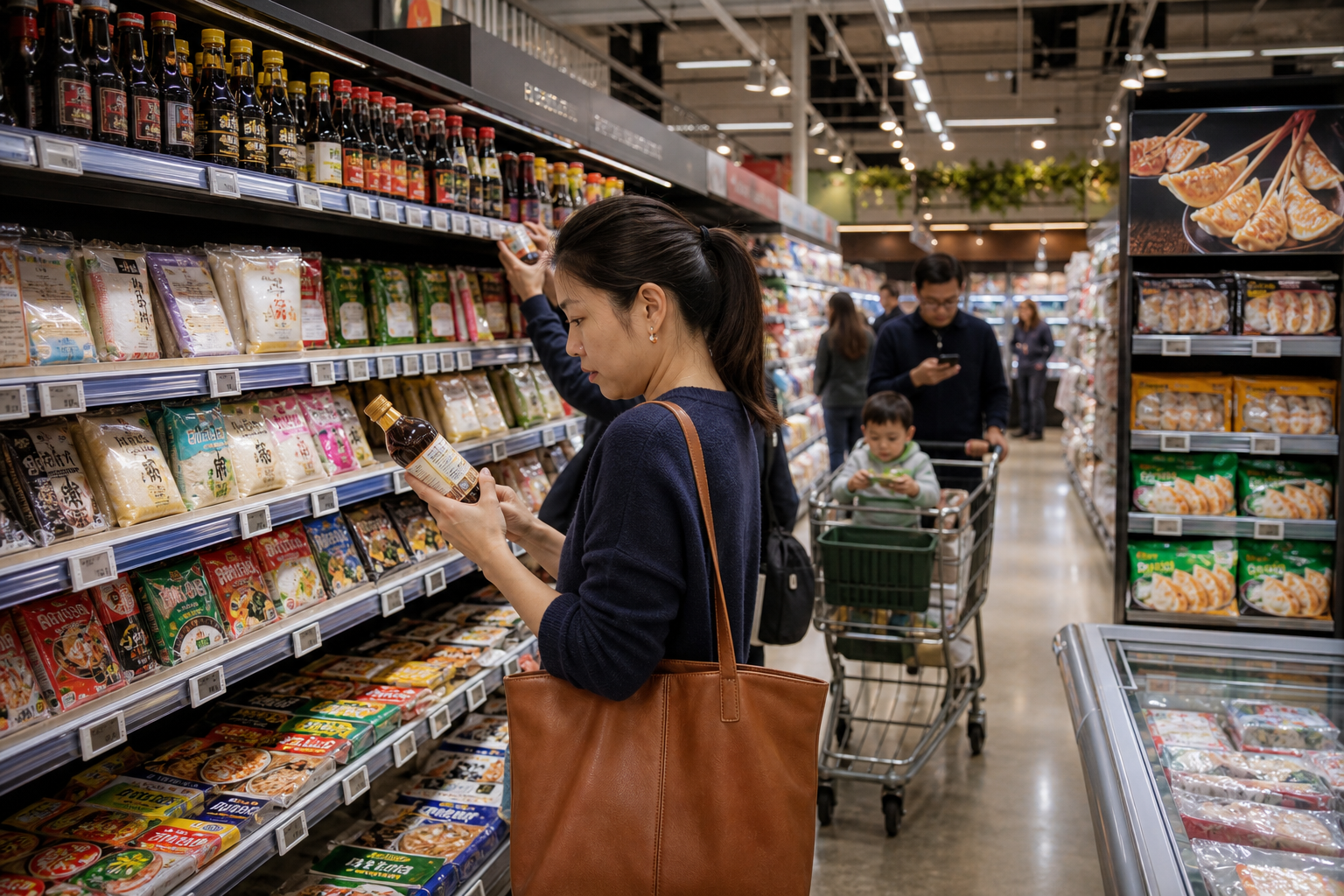

Premium positioning alone can no longer absorb the cost of importing food into Australia. Inside FMCG reported on 7 September 2026 that average weekly grocery spending for a four-person household had reached A$245, up 2 percent, while a comparison basket rose from about A$214 in March 2025 to A$232 in July 2026. Shoppers were reducing treats, checking unit prices, buying marked-down items, and moving toward private label. Japanese food brands therefore need a value architecture that explains the reason for the price and the value per use, rather than relying on discounting.
Contents
- How shopper behaviour is changing
- From expensive Japanese food to usable value
- Price and pack architecture
- Promotion and repeat purchase
- Channel and portfolio roles
- A 90-day action plan
1. How shopper behaviour is changing
Inside FMCG explains that inflation does not affect every household in the same way because the burden changes with categories and substitution. Consumers are moving from beef to chicken, branded goods to supermarket labels, planning meals around promotions, and using leftovers. In the Canstar findings cited, 40 percent had reduced treats and snacks, 38 percent spent more time checking unit prices, 30 percent bought marked-down products, and 25 percent used home brands.
Demand is not simply moving to the cheapest item. Shoppers are becoming more selective. A premium can survive when taste, convenience, family preference, and lower waste justify the difference. A narrow-use product that is hard to finish or understand can feel poor value even at a similar shelf price. Importers need to show cost per meal and number of uses, not only price per bottle.
These figures are a market snapshot and should not be projected identically across every state, income group, or category. Even so, the combination of unit-price checking, substitution, promotion, and waste reduction is a strong reason to redesign the value proposition. Products exposed to freight and exchange-rate pressure need an especially clear explanation of utility and yield.
2. From expensive Japanese food to usable value
Japanese food can create value by delivering flavour in a small dose, working across dishes, reducing preparation time, replacing a restaurant occasion, or storing well. A concentrated tsuyu may have a high bottle price but a low cost per use across noodles, simmered dishes, donburi, and dressings. Frozen gyoza can replace a meal out and allow households to cook only what they need. Premium nori is easier to value when one sheet completes a lunch or snack.
“Made in Japan” is not, by itself, a reason for a high price. Japanese ingredients, regional methods, and craftsmanship can support taste difference, consistency, scarcity, or a premium, but they must connect to use. A premium dashi might deliver restaurant-style soup quickly. A simpler ingredient list can be meaningful to shoppers who read labels. The reason to pay should be specific.
Information that reduces failure is part of value. English dosage guidance, recipes, short QR videos, heat or salt scales, and after-opening storage instructions reduce first-purchase anxiety. Dilution and preparation knowledge that is obvious in Japan may be unfamiliar in Australia. A product that remains unused because instructions are weak is poor value regardless of shelf price.
3. Price and pack architecture
One size rarely serves both trial and repeat use. Consider a trial pack, a core household pack, and a heavy-user or foodservice pack, but do not import all of them immediately. Test whether a smaller initial outlay or better unit economics removes the main barrier, then use velocity and repeat data to determine the next size.
Small packs lower the shelf price but raise packaging and logistics cost per unit. Large packs improve unit price but raise initial spend and waste risk. Pack size should follow frequency of use and after-opening life. A weekly condiment and a daily tea require different designs. Compare shelf price, price per 100 grams or millilitres, cost per use, and the number of uses possible before quality declines.
Give entry, core, and premium products distinct roles. Entry creates trial, core produces repeat sales, and premium communicates regionality or ingredient difference. An all-premium range can become confined to specialty shopping; an all-low-price range may not absorb freight and promotion. Margin and recognition should be managed across the portfolio.
4. Promotion and repeat purchase
Discounts create trial, but a business only forms when customers repurchase at the normal price. Compare promoted and unpromoted groups and track the four to eight weeks after the promotion. Separate launch data from retention data, including normal-price velocity, cross-purchase within the brand, recipe use, and review content.
Test value communication beyond discounting: sampling, adjacent merchandising, meal solutions, bundles, and usage sets. Udon, tsuyu, and shichimi may be easier to understand as a 15-minute meal for two than as three isolated products. Yet if the items only sell together, the individual proposition may be weak. Measure both bundle and standalone demand.
Set funding and supply limits for each promotion. Wide retail discounting can require rebates, execution spending, and additional stock. Long import lead times create risks of both out-of-stock and excess inventory. Define the promotion objective, such as acquisition, stock reduction, usage education, or competitive response, and avoid blanket discounting without a specific purpose.
5. Channel and portfolio roles
Major supermarkets focus on unit price and velocity; specialty stores on assortment and explanation; online channels on acquisition cost; and foodservice on cost per plate and labour. The same product needs a different expression of value: cost per use in grocery, provenance in specialty, usage video online, and yield and preparation time in foodservice.
During value pressure, specialty and foodservice channels can build product understanding before a retail pitch. Restaurant use demonstrates taste and operational fit, while specialty repeat purchase shows a core audience. Pricing must remain coherent across channels. Recommended retail, foodservice price, and online price including delivery should be designed together.
Assess portfolio products by role as well as revenue. Some attract customers, some generate margin, some symbolise the brand, and some increase the use of another product. A slower line can have a strategic role, but that role and its inventory limit must be explicit. Storytelling should not excuse unbounded loss-making stock.
Set a price-review rule before entry. Changing shelf price every time exchange rates or ocean freight move undermines buyer and consumer confidence, but absorbing every change can erase importer margin. Manufacturer and importer should agree a reference exchange rate, review frequency, trigger range, and treatment of stock already landed, with reasonable notice to retail partners. Short movements may be absorbed, while structural changes can trigger a broader review of pack, case, and promotional terms rather than an automatic price increase.
Comparative value also needs transparent assumptions. If a label or sales sheet uses diluted cost or cost per meal, state the serving assumption and keep it consistent with real use. Reference prices and limited-time reductions should follow Australian consumer law and retailer rules. Explaining value is different from making a product merely look cheap. Trust is built when repeat buyers still find the arithmetic credible.
6. A 90-day action plan
In the first 30 days, record competitor shelf price, unit price, size, promotional frequency, origin, and claims, and update total landed cost. Calculate value per meal for three use occasions and select the clearest one for pack and sales material. Establish a price band that works for importer, retailer, and consumer, including scenarios for freight and exchange-rate increases.
From days 31 to 60, test two options among a small pack, standard pack, and bundle. Use normal price as the base, with sampling or discounting in only part of the test. Record velocity, margin, repeat purchase, questions, and waste. Identify which customer chose the product for which use, rather than concluding only that the cheaper option sold more.
From days 61 to 90, narrow the range and build the promotion and replenishment plan. Make products that survive at normal price the core. Rework size, occasion, or communication for products dependent on discounting. Give buyers a one-page view of competitors, value per meal, trial evidence, normal-price repeat, and supply scenarios.
In an inflationary market, the objective is not to be the cheapest but to offer value shoppers can compare. Price, size, uses, reliability, storage, and restaurant replacement can allow Japanese products to combine premium quality with practicality. umamill Co., Ltd., with roughly 7,000 Japanese food SKUs, can be one source for comparing candidates across pack sizes and price bands when building an entry and core range. The first metric to revisit is not bottle price but cost per meal and normal-price repeat purchase.
---------------------------------------------------------------------------------
References
“How Australians rethink grocery shopping amid food inflation”, Inside FMCG, 7 September 2026:
https://insidefmcg.com.au/2026/09/07/how-australians-rethink-grocery-shopping-amid-food-inflation/