
Convenience in the U.S. food market is becoming more than a time-saving feature; it is increasingly a reason to buy. The 2026 research highlighted by The Food Institute found that convenience surpassed healthfulness as a grocery purchase driver for the first time. For Japanese foods, the opportunity is not simply to describe an existing product as easy to prepare. Importers need to define whose burden the product removes, at what unpredictable moment of the day, and then align the format, portion, price, channel, and message around that occasion.
Contents
1. What This Week’s Coverage Says About Demand
2. Reframe Japanese Foods Around Occasions, Not Dish Names
3. Optimize Convenience Together With Taste, Price, and Nutrition
4. Packaging and Placement Complete the Convenience Experience
5. Economics and Execution Conditions Importers Often Miss
6. A 90-Day Market Test
7. Conclusion: Make Convenience a New Entry Point to Japanese Food
1. What This Week’s Coverage Says About Demand
According to The Food Institute, the International Food Information Council’s 2026 Food & Health Survey found that convenience rose from 52% in 2025 to 61% as a grocery purchase driver, exceeding healthfulness at 56% for the first time. Taste remained the leading factor at 88%, and price ranked second at 78%. The correct interpretation is not that consumers will accept anything convenient. They want to reduce preparation, cleanup, and decision time while preserving taste, reasonable pricing, nutrition, and understandable ingredients.
The article also describes eating patterns dispersing beyond conventional breakfast and dinner into smaller meals, snack-style eating, and grab-and-go occasions. The issue is not only how busy consumers are, but how inconsistent their schedules have become. Meetings, school pickup, exercise, delayed commutes, and reduced appetite can matter more than the traditional breakfast-lunch-dinner framework. Smaller appetites associated with GLP-1 use and the feeling that full-meal preparation is disproportionate to the amount a person expects to eat also support compact, satisfying formats.
Price pressure creates another opening. Consumers may want to avoid restaurant prices without committing to substantial home cooking. The article’s examples in frozen foods and club-store multipacks point to a middle ground: a meal with restaurant-like satisfaction at lower cost and with little effort. Japanese food importers can therefore add an “affordable restaurant alternative” proposition to cultural authenticity, provided the finished consumer experience supports that promise.
2. Reframe Japanese Foods Around Occasions, Not Dish Names
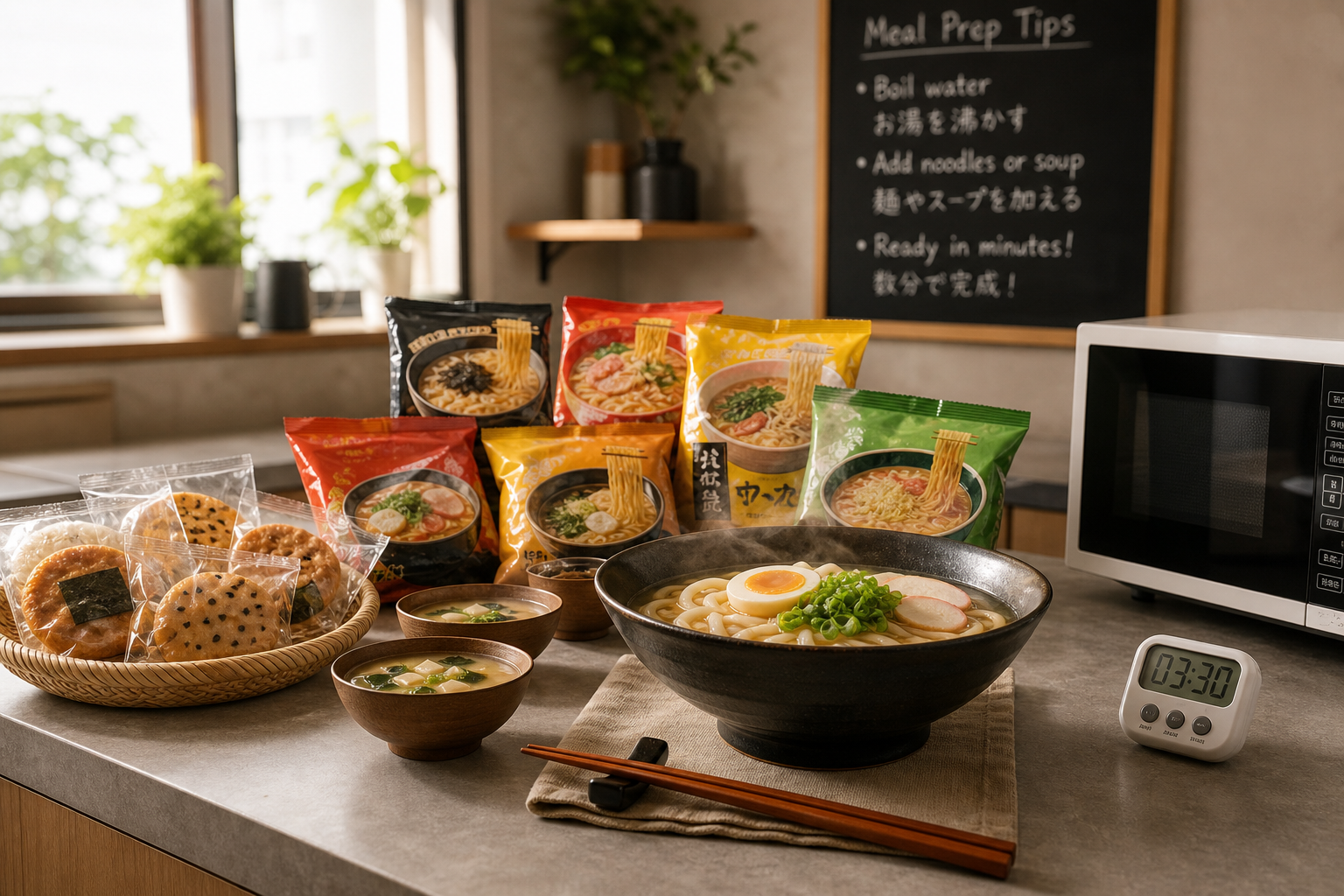
If assortment planning begins only with categories such as udon, curry, or miso soup, it is easy to compare products but harder to see the consumer problem. Begin with the occasion and then assemble the Japanese products that solve it. A warm lunch in under five minutes might combine frozen udon, shelf-stable soup base, and dried toppings. An afternoon snack might use portioned rice crackers, seaweed, or sesame and bean snacks. A light late-night meal could be ochazuke, rice porridge, or freeze-dried miso soup in a smaller format.
The required specification changes with the occasion even when the food is similar. Office lunch favors microwave-compatible packaging, limited aroma, and very short instructions. Eating between trips favors one-hand handling, resistance to spills, and ambient storage. A household’s “I do not want to cook tonight” occasion may require flexible family portions, multipacks, meal-pairing guidance, and packages that fit efficiently in a freezer. The real product evaluation should count every step removed before and after eating.
Japanese convenience foods already offer useful assets: quick preparation, individual packaging, shelf stability, and strong satisfaction from dashi-based flavor. Yet a serving convention that feels obvious in Japan may be unfamiliar to a first-time U.S. buyer. Even “add hot water” needs a clear water volume, wait time, serving suggestion, and pairing cue. Reducing the distance to a successful first use is generally more valuable than adding a long cultural explanation.
3. Optimize Convenience Together With Taste, Price, and Nutrition
Because taste and price remain leading purchase drivers, time savings alone may not justify a large premium. Importers should place the final shelf price, after freight and channel margins, against restaurant takeout, prepared foods, and mainstream U.S. frozen meals. Value becomes easier to explain when price per serving is shown alongside preparation time, reduced waste, and repeat uses. A large pack may look economical but feel less convenient if a smaller household throws part of it away.
Protein, fiber, and an appropriate serving size can be useful when they naturally fit the occasion, but every product does not need to become a high-protein product. Japanese foods can also deliver structural benefits through savory dashi satisfaction, beans, grains and sea vegetables, less reliance on frying, or a warm component prepared in minutes. Nutrition and health language must be supported and reviewed for U.S. requirements. Start with the formulation and available analysis, then select defensible language, rather than deciding on a claim first.
Localization should not simply mean making flavors stronger. Separate a recognizable entry point from the distinctly Japanese layer that creates depth. Teriyaki, curry, yuzu, and matcha can provide familiar signals, while dashi, koji, sansho, or black sesame can be introduced progressively. During testing, ask more than whether participants like the flavor. Ask when they would eat it, what it would replace, what they would pair it with, how much preparation they would tolerate, and at what price the substitution makes sense.
4. Packaging and Placement Complete the Convenience Experience
Convenience is not complete until the packaging makes it visible and achievable. The English-facing panel should make preparation time, heating method, servings, and storage easy to scan. Directions should use a few clear steps and address microwave power differences or hot-water safety where relevant. Hidden steps such as finding another bowl, opening several sachets in sequence, or measuring liquid can damage the first-use experience. Whenever possible, observe U.S. users from opening through disposal.
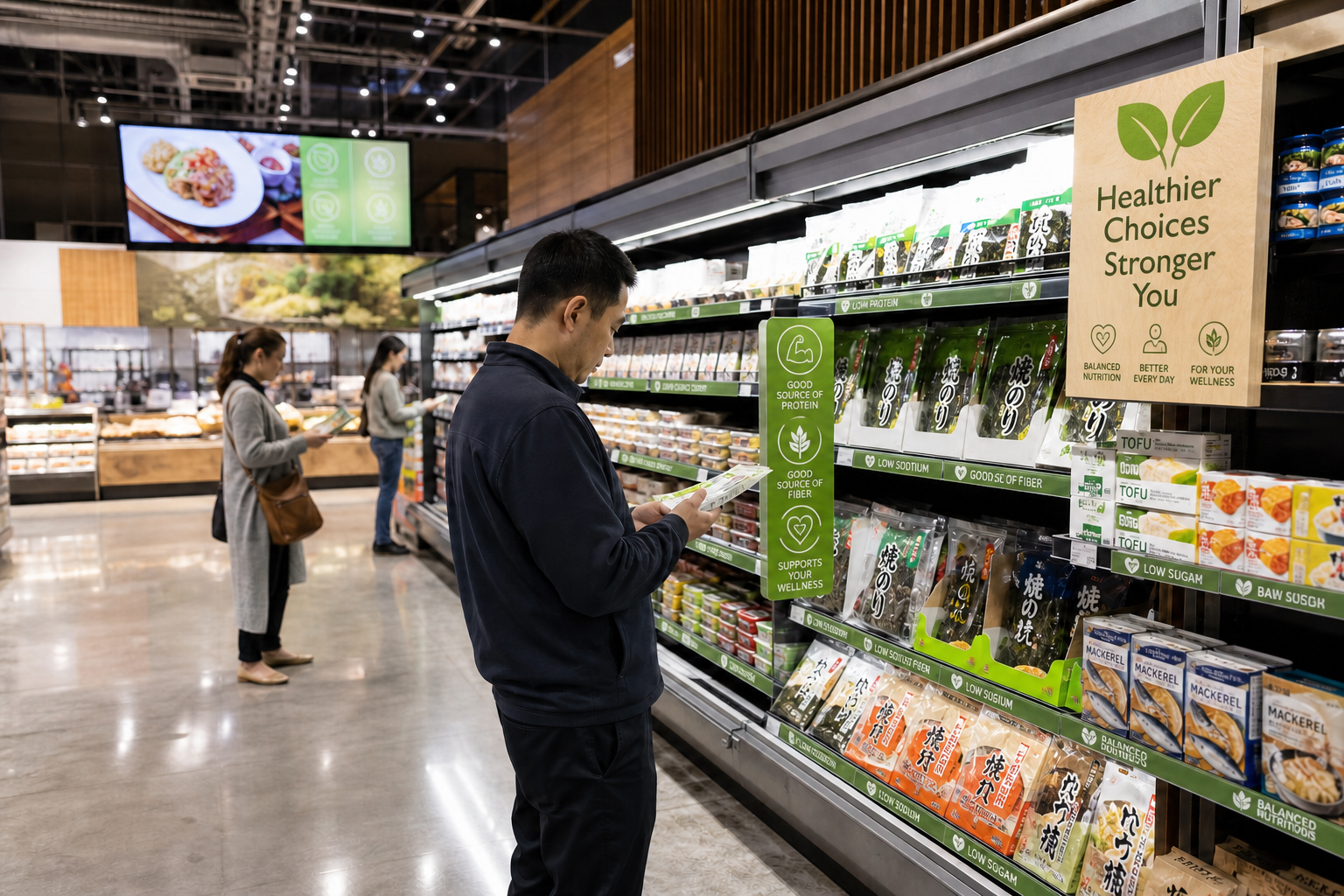
Placement should also reflect the occasion. The Asian aisle reaches consumers already seeking Japanese food, but it can miss a shopper whose immediate goal is simply an easy dinner. Comparison in frozen meals, instant soup, lunchbox snacks, or wellness beverages may be more valuable. Secondary displays and cross-merchandising can show a complete occasion: frozen udon with broth, instant miso soup with rice, or rice crackers with tea. E-commerce pages should show the steps, portion scale, storage dimensions, and use context in addition to a finished dish.
The meaning of convenience changes by channel. Specialty stores reward discovery and authenticity; mainstream grocery needs immediate comprehension and price logic; club stores need repeat use and manageable bulk; convenience stores prioritize immediate consumption; and foodservice buyers focus on labor reduction and yield. Rather than pushing one SKU everywhere, adjust pack size, inner count, case dimensions, preparation, and sales materials to the channel.
5. Economics and Execution Conditions Importers Often Miss
Ambient, chilled, and frozen convenience foods carry very different economics. Frozen products can protect eating quality but create storage costs, minimum-order constraints, geographic limits, and competition for freezer space. Retort and dry products can travel more widely, yet weight, cube, remaining shelf life, and damage still shape profitability. Contribution should be evaluated using case cube, pallet efficiency, temperature-zone consolidation, and expected velocity, not product margin alone.
Ingredient naming, allergen presentation, nutrition facts, facility registration, and other requirements should be screened while selecting products, not immediately before launch. An ingredient or compound seasoning common in Japan may require a different English declaration or treatment in the United States. This article is not legal or regulatory advice; actual admissibility and labeling should be reviewed SKU by SKU with qualified U.S. regulatory, customs, and importing professionals. Late discovery can erase the speed advantage the product was supposed to deliver.
Supply planning must balance replenishment reliability with the risk of excess inventory. Manufacturing lead time and ocean transit make promotional spikes difficult to cover, but heavy opening inventory is equally dangerous for short-dated or seasonal items. A limited-region or limited-channel test is often the better start. Track out-of-stocks, expiry, markdowns, and reorder intervals to determine whether the product creates durable shelf velocity rather than only initial shipment volume.
6. A 90-Day Market Test
In the first 30 days, organize candidate SKUs by occasion and write one sentence defining who eats each product, when, instead of what, within how many minutes, and at what price. The competitive set should include frozen bowls, deli foods, bars, delivery, and restaurants, not only Japanese products. Compare shelf price, preparation time, portion, nutrition, and storage. Screen import, labeling, and logistics red flags early so the team does not spend weeks taste-testing an option that cannot be executed.
During the next 30 days, narrow the work to two or three occasions. Build an English label concept, product page, and simple sales material, then conduct consumer testing and buyer conversations. Ask where the product would be stored at home or work, what it would replace, and the acceptable price. Ask retail and distribution partners about placement, case pack, expected velocity, promotion cadence, and data sharing. Record preparation failures separately from flavor response so a packaging issue is not mistaken for a product issue.
In the final 30 days, launch a limited regional and channel test. Important measures include four- and eight-week repeat, store-level velocity, availability, markdowns, preparation complaints, and whether the observed occasion matches the planned one. If results are weak, isolate whether the problem is the occasion, price, directions, or placement before adding more SKUs. Replicating only a proven occasion protects imported inventory while accelerating learning.
- Define the consumer occasion first and assign the category afterward.
- Explain value through time, waste, and avoided restaurant spend, not shelf price alone.
- Measure repeat, velocity, and preparation failures, not only the first shipment.
7. Conclusion: Make Convenience a New Entry Point to Japanese Food
This week’s coverage does not show that health has disappeared. It shows that consumers expect taste, price, and wellness to work within real daily constraints. Japanese foods have strong assets in rapid preparation, satisfying smaller portions, shelf-stable and frozen technologies, and individual packaging. When those strengths are translated into a specific occasion, clear directions, a suitable portion, and a comparable price, they give unfamiliar consumers a concrete reason to choose Japanese food.
At the product-discovery stage, it is useful to compare several categories around one occasion rather than restricting the search too early. With a broad lineup of roughly 7,000 Japanese food SKUs, umamill can help businesses explore convenience foods, seasonings, snacks, and beverages that fit a defined U.S. use case. The practical first step is to choose one busy moment and build the smallest, clearest product solution that turns it into a satisfying meal or snack.
-------------------------------------------------------------
Source reference
On Demand Is in Demand: Convenience Drives More Purchases Than Health — The Food Institute, July 28, 2026
Open the original article